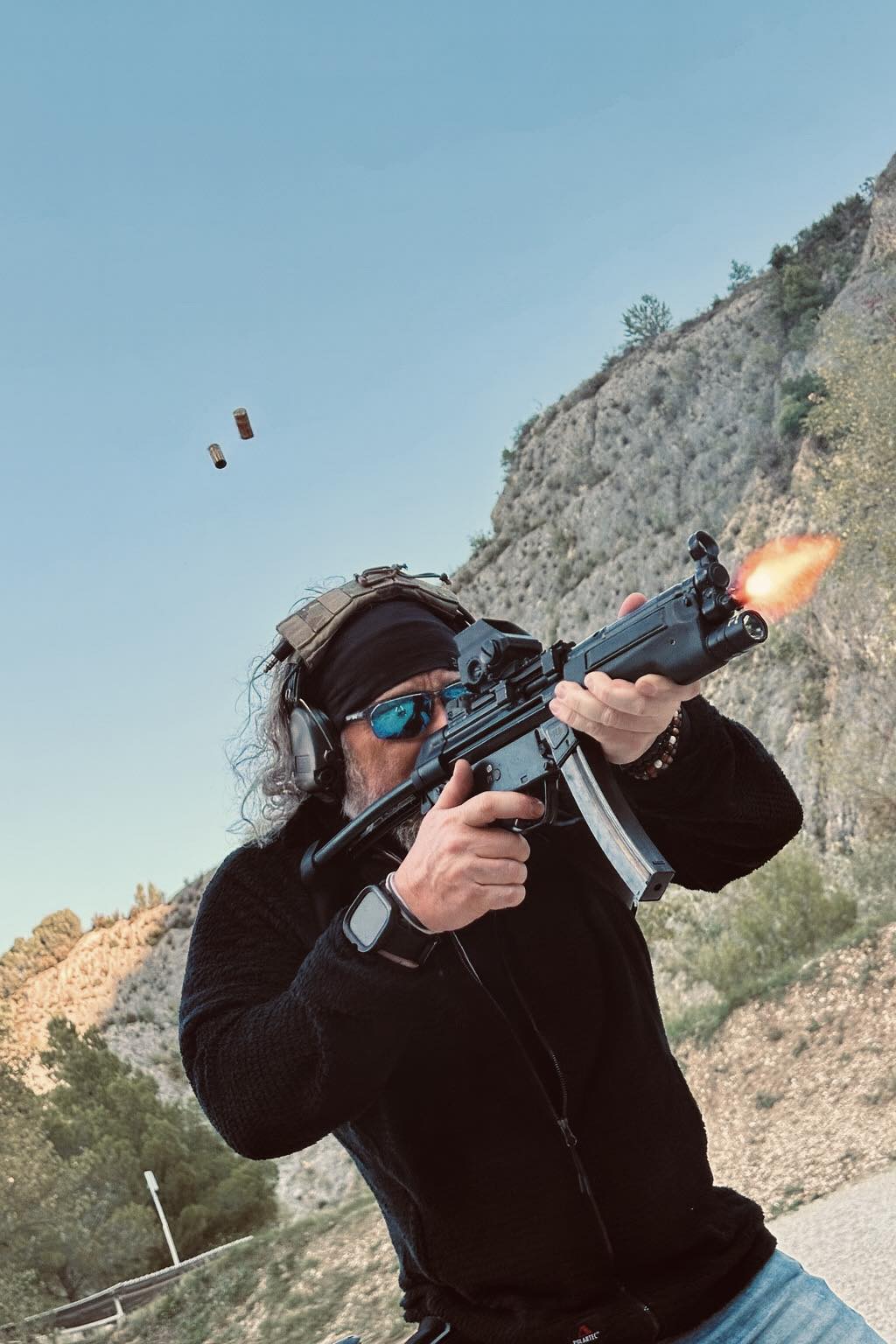
DETAILS MAKE THE DIFFERENCE
It is something I have been stating for years, particularly within Special Units. An operator is defined as “special” because of the level of detail he is able to reach in every single segment of application. Without this obsessive attention to detail, what would truly make a Unit “Special”?
In the civilian market, however, attention to detail during training is very often neglected. This happens consistently, and almost always for the same three reasons.
The first reason is the lack of adequate knowledge on the trainer’s side.
This occurs because many trainers develop their entire technical foundation exclusively within the shooting-range environment, without ever experiencing the real application of those principles beyond it.
The second reason is the absence of a teaching structure, or the lack of a real method.
This is typical of trainers who have spent years in law enforcement or military environments and believe that simply repeating what they have heard or applied over time is enough to automatically transform experience into effective instruction.
In reality, if experiential knowledge is not sorted, filtered, structured, and translated into a form usable by a civilian, the training impact becomes ineffective, unclear, or weak.
The lack of a structured didactic system is also typical of those who qualify as instructors after a few basic shooting-range courses, without the necessary technical and experiential foundations, and especially without any real experience applying those skills outside the range. This is not only the most common scenario, it is also the most dangerous one.
The third reason is the trainer’s wrong mindset.
Very often, trainers believe that going into detail is unnecessary because it requires more effort and more teaching time, which does not always align with the time-to-money ratio.
Online, I frequently see entire training segments, particularly on the fundamentals of shooting, compressed into a few sentences, a couple of tricks, and the inevitable phrase: “Do whatever you want, as long as it works for you.”
These fundamentals, when treated correctly, are complex. Reducing them in this way does not simplify them, it empties them of meaning.
It is true that each individual has different physical and biomechanical characteristics, which generate different dynamics from subject to subject. It is also true that everyone will absorb the same technique differently, adapting it to their own body. However, the principle “do whatever you want” has no place in professional training.
This is not a personal opinion. It is confirmed by logic, common sense, and the observable reality of the facts.
Firearms training is a complex discipline because it is based on the interaction of four fundamental elements: the shooter, the firearm, the target, and the environment.
Each of these elements represents a system of multiple variables and parameters, making their interaction highly complex and continuously variable.
If we do not build solid and effective dynamics to support the interaction of each element, and then of all elements together, we cannot achieve effective interaction, and therefore we cannot achieve correct execution of the discipline.
Consider what would happen if someone started playing golf and the instructor told them they could swing however they wanted, or if a tennis coach said the backhand or serve could be executed in any way the player preferred. By simple logic, this would make no sense, and the outcome would be obvious.
Every discipline has its own specific dynamics. The higher the level of technical difficulty required, the greater the level of precision, depth, and attention to detail must be.
With firearms, nothing is random. We do not move a single muscle without a precise reason. We leave nothing to chance, and we do nothing arbitrarily in terms of technique or application.
If I were to teach the fundamentals of shooting using the approach “it’s very simple, do what feels best or most comfortable to you,” I could explain everything in ten minutes. Instead, at a basic level alone, those fundamentals require a six-to-eight-hour teaching module.
If trainers educate users through superficiality, then we cannot complain when people believe they can learn to shoot in a single day, or in a few hours on the range, or when they think a three-day course is enough to become an instructor.
Do not make the mistake of being satisfied. Demand the development of detail to the highest possible level. This has nothing to do with oversimplifying the subject or misunderstanding the KISS principle. Simplifying does not mean removing depth. Simplifying means making the subject usable, transferable, and understandable, both theoretically and practically.
Simple does not mean superficial.
And very often, it does not mean easy.